Category: Buying A Lake Home

  • 11 Most Costly Mistakes When Buying a Florida Lake Home

    11 Most Costly Mistakes When Buying a Florida Lake Home

    A lake home in Florida can be the best purchase your family ever makes.

    It can also be the most expensive lesson you ever pay for.

    I wake up every morning on Lake Eloise in Winter Haven. I grew up on Lake Link, lived on Lake Summit for a good stretch, and spent a year on Lake Hatchineha. And over the years I’ve watched friends and other families overpay… get stuck with a dock they couldn’t legally rebuild… or find out their “lakefront” floods in ways nobody disclosed.

    Here’s the frustrating part.

    Almost NONE of it had to happen. Nearly every one of those problems was sitting in a free public database, about ten minutes of clicking away.

    So I wrote it all down in a free 31-page guide: 11 Costly Mistakes to Avoid When Buying a Lake Home in Florida. What follows are the highlights. The full guide has the how-to for each one, the checklists, and every link you need to look it all up yourself.

    Want the full version right now? Get the free Florida Lakefront Buyer’s Guide here.

    Buying lakefront is like buying a boat with the hull underwater. You get to inspect the deck, the stereo and the paint. The part that decides whether you’re happy for the next twenty years is the part nobody shows you.

    Let’s look under the waterline.

    1. Treating every “lakefront” listing as the same thing

    In Florida, “lakefront” covers everything from a 600-plus-acre natural lake on a navigable chain to a man-made stormwater pond behind a subdivision.

    Think of it like “steak” on a menu. Filet mignon and cube steak are both, technically, steak. Only one of them is worth sixty dollars.

    Pay a true-lakefront premium for water you can’t boat, fish or swim in, and you find out after closing… when that premium is baked into a price you may never recover at resale.
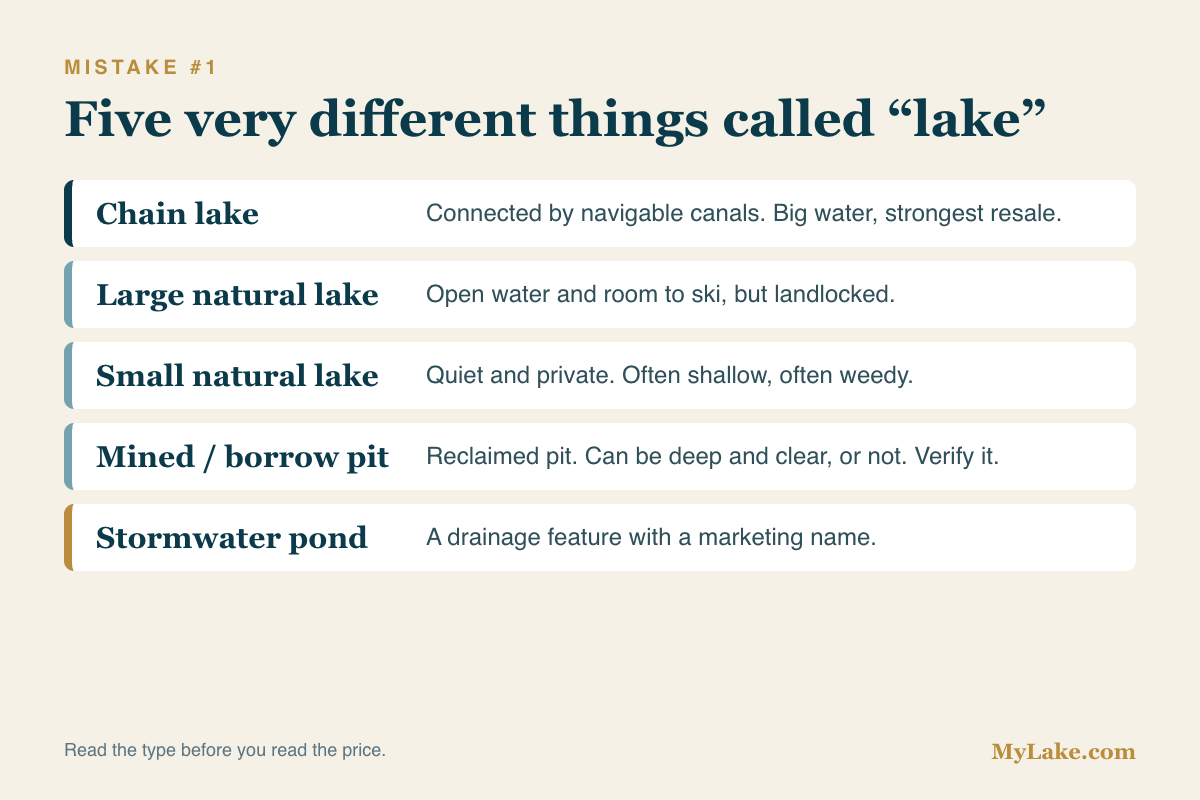
    Chart of five types of Florida lakes: chain lake, large natural lake, small natural lake, mined or borrow pit, and stormwater pond

    The fix: Judge the water first and the house second. You can always update a house. You can’t change a lake.

    2. Skipping the lake’s water history (algae, nutrients and weeds)

    A lake can look postcard-perfect the day you tour it and still carry a documented history of blue-green algae, nutrient problems, or a hydrilla mat that swallows the shoreline every August.

    None of that shows up in the listing.

    Here’s the seasonal trap, and it’s completely legal. The lake gets treated in March. The listing photos get shot in May. You close in July. In August you walk out to your dock and the surface looks like a putting green.

    Nobody lied to you. You just saw the lake on its three best days of the year.

    The fix: Pull the free record before you commit. Florida LAKEWATCH has decades of sampling data on hundreds of Florida lakes, and the state tracks algae blooms and weed treatments lake by lake. The guide walks you through exactly which free tools to check, and what to look for in each one.

    3. Assuming today’s water level is permanent

    Florida lakes rise and fall with the rainy season, drought cycles, and whether the level is regulated at all. Sometimes by many feet.

    In my own county, water management district records show Lake Mabel’s high and low of record sitting more than twelve feet apart.

    A friend of mine bought in late summer when the lake was at a five-year high. His dock sat a perfect two feet above the water the day he moved in. The following spring the lake dropped back to normal… and that dock stood more than five feet above the water.

    The fix: Find the lake’s high and low of record before you buy, and ask the seller for photos from a wet year and a dry one.

    4. Assuming you can build the dock you’re picturing

    Buyers assume a dock, a boat lift or a bigger slip is a given. It isn’t. Docks are regulated by the state, your water management district, sometimes the Army Corps of Engineers, and your county on top of that.
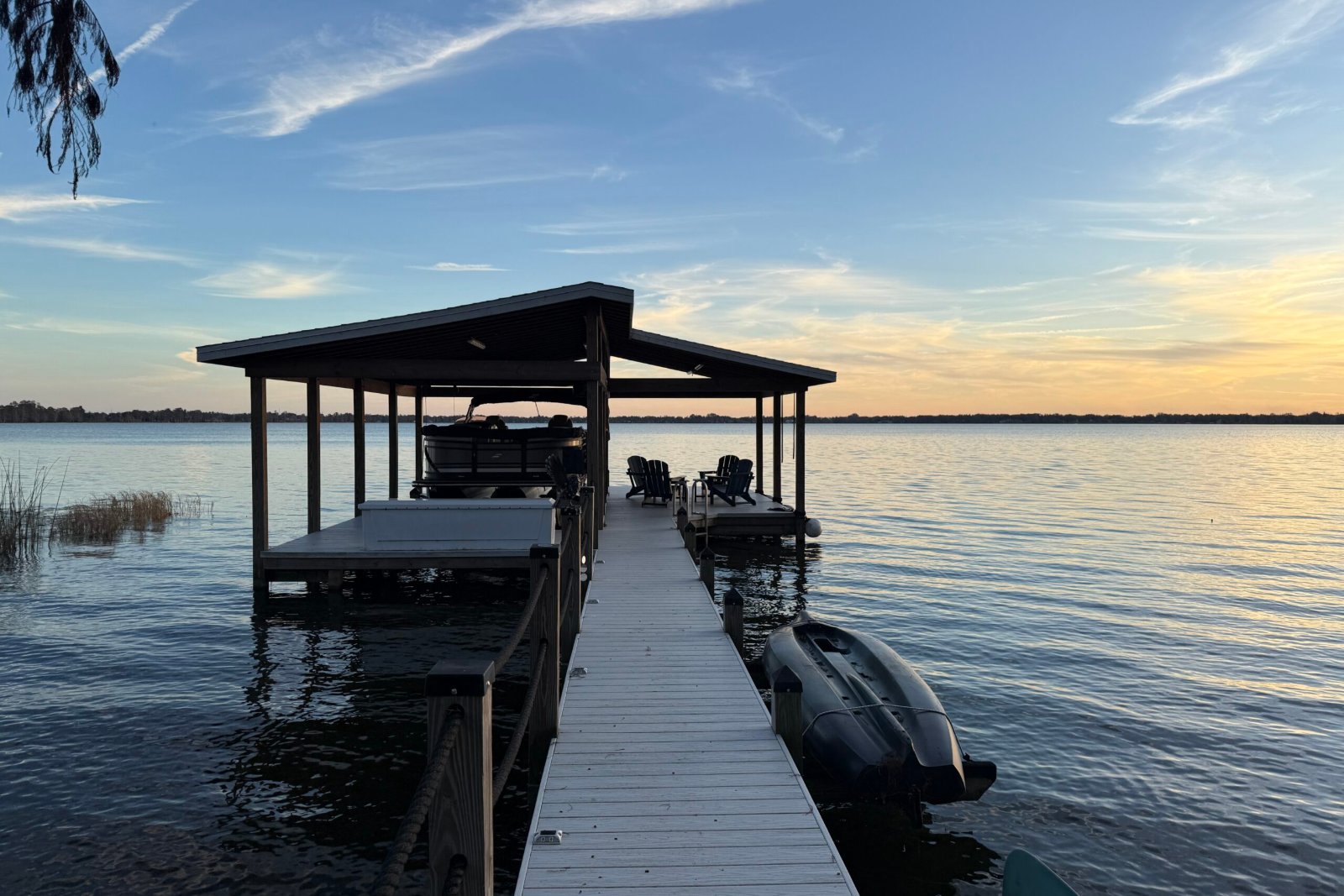
    Long walkway dock leading to a covered boathouse with a pontoon boat on a Florida lake at sunset

    A grandfathered dock is like a grandfathered insurance policy. It protects you right up until the day you touch it.

    Tear down that big old dock to build your dream dock, and the exemption it was standing on can go with it. And if your lake is designated an Outstanding Florida Water, the exempt dock footprint is cut in half.

    The fix: Make dock permittability a written contingency in your offer, not a hope. The guide covers the square-footage rules, setbacks, and what counts toward your footprint (boat lifts do).

    Four down, seven to go.

    The full guide includes the 10-Minute Lake Background Check: ten free public tools that tell you a lake’s history before your first showing.

    Send me the free 31-page guide →

    5. Reading the flood zone instead of the flood reality

    Plenty of buyers still assume “Zone X means safe.” Under FEMA’s Risk Rating 2.0 pricing, the zone letter no longer sets your premium. Your actual structure does: elevation, foundation, distance to water, replacement cost.

    Two nearly identical homes on the same street can carry flood premiums thousands of dollars apart.

    The fix: Get an actual premium quote for that specific address, not a zone letter. Ask for the elevation certificate. And don’t leave it to closing week, because a new NFIP policy typically carries a 30-day waiting period.

    6. Overlooking the seawall and shoreline

    The seawall is the foundation of a lake house. Nobody buys a house with a cracked foundation, but plenty of careful people buy one with a failing seawall… because they were looking at the sunset instead of the wall.

    A failing seawall can cost tens of thousands of dollars to replace, and shoreline work is regulated too.

    The most expensive warning sign is the least dramatic one: a soft spot or sinking sod in the lawn right behind the wall. That’s soil washing out through it.

    The fix: Have the shoreline inspected separately from the house, and get two written bids from marine contractors during your inspection period.

    7. Ignoring the septic system by the water

    Many older Florida lake homes run on septic, sometimes close to the shoreline.

    The real risk usually isn’t the repair bill. It’s that the old system may not be replaceable in kind. It was installed under yesterday’s setbacks, and under a 2023 state law, new septic systems on lots of one acre or less inside a Basin Management Action Plan area must be enhanced nutrient-reducing systems, which cost meaningfully more than a conventional tank.

    The fix: Locate it, pump it and inspect it, in writing. Then ask a septic contractor one question before you close: “If this fails, where does the replacement go?”

    8. Confusing “lake access” with true waterfront

    “Lake access,” “lake community” and “water view” are not the same thing as deeded frontage you actually control.

    Deeded frontage is a driveway. Community lake access is a bus stop. Both technically get you to the water. Only one of them is yours at 6:40 on a Saturday morning with your boat already on the lift.

    The fix: Read the survey and the deed. Order a boundary survey with the shoreline located, and confirm exactly where your ownership and riparian rights begin and end.

    9. Valuing the house instead of the water

    Buyers tend to judge lake homes like subdivision homes: square feet, granite, price per foot. On the water, the land and the lake drive most of the value.

    The house is the tenant. The land is the landlord.
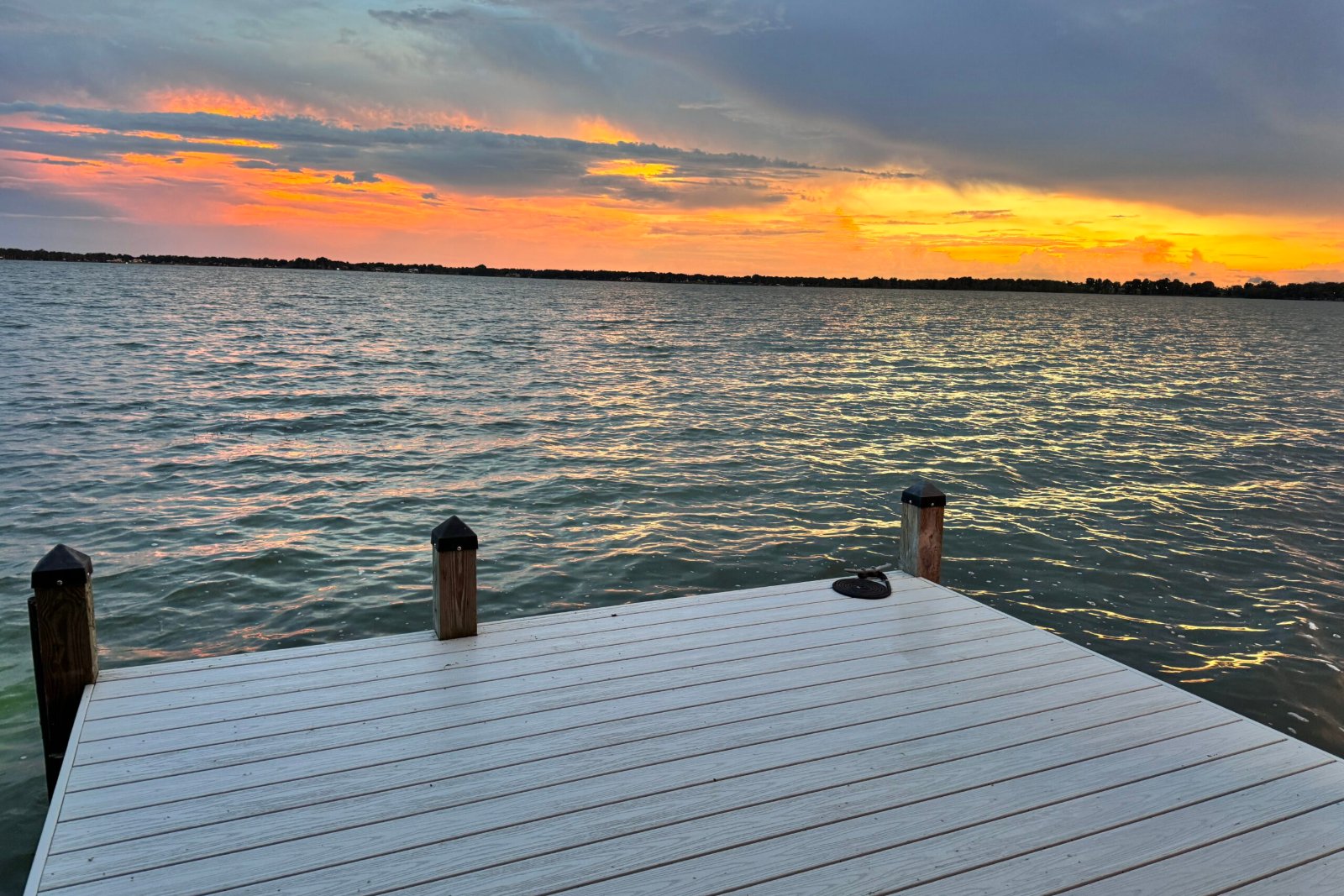
    End of a dock looking across wide open water on a Florida lake at an orange sunset

    Kitchens get redone. Roofs get replaced. Nobody has ever added forty feet of frontage, moved a lot from a windy point into a calm cove, or turned a muck bottom into sand. (It’s also a big reason prices vary so much from one lake to the next. Here’s a look at the 10 most expensive lakes in Winter Haven.)

    The fix: Score the water before you score the kitchen. The guide includes a 70/30 scoring table that weights the water over the structure: lake quality, frontage, depth at the dock, bottom composition, orientation, exposure, connectivity and privacy.

    10. Trusting the Zestimate and today’s tax bill

    This one happened to me.

    The house we bought on Lake Eloise had been owned by the same couple for 28 years. My tax bill DOUBLED the first full calendar year after we bought it.

    That wasn’t a mistake by the county. It’s how Florida works. The Save Our Homes cap keeps a homesteaded owner’s assessed value low for years, then resets when the home sells. The previous owner’s low tax bill didn’t convey. (I wrote more about that, and two other things I’d do differently, in 3 Mistakes I Made Buying a Lake House in Florida.)
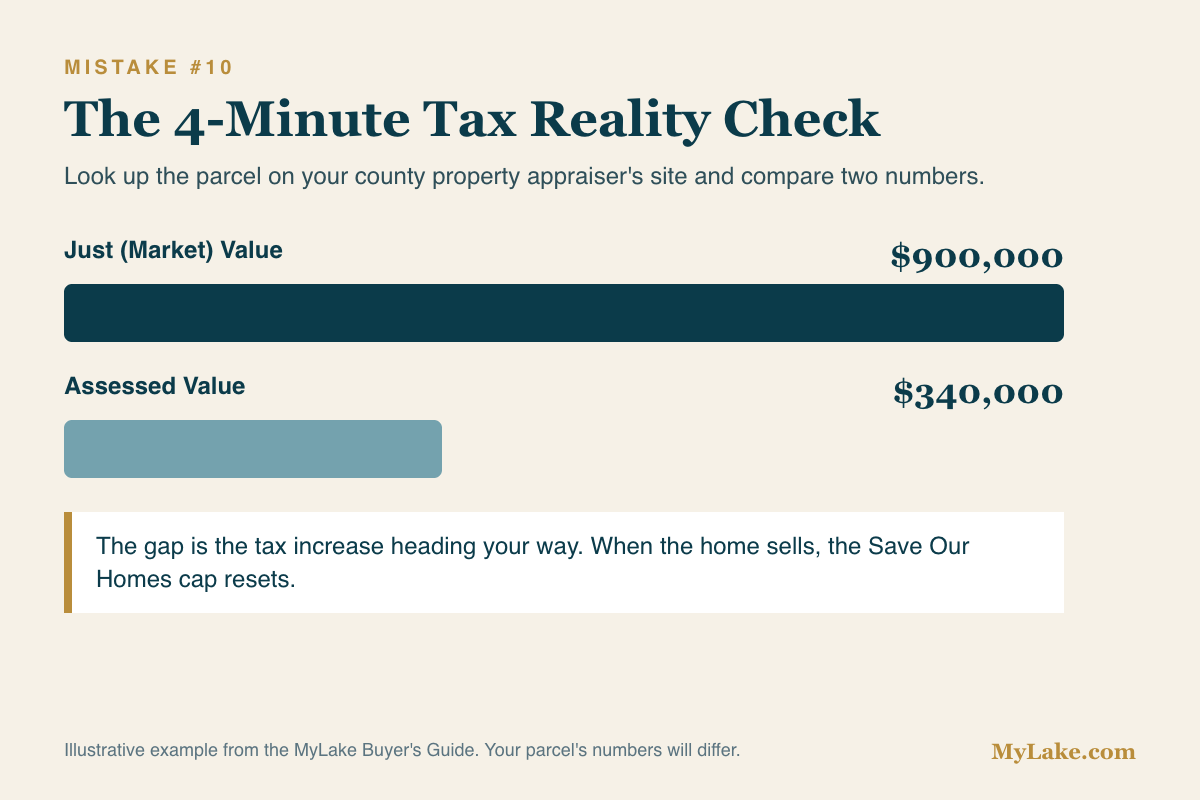
    Bar chart comparing an example Just Value of $900,000 to an Assessed Value of $340,000 on a Florida property card

    Automated values have the same blind spot from the other direction. A Zestimate has no field for frontage, depth at the dock, bottom composition or bloom history, so it can treat a 60-foot muck lot and a 140-foot sand-bottom lot as roughly the same house.

    The fix: Compare Just Value to Assessed Value on the county property appraiser’s site before you write the offer, and insist on comparables that account for frontage, lake, depth and orientation.

    11. Buying the house and forgetting the life you came for

    You are not buying a house. You are buying about nine hundred Saturdays.
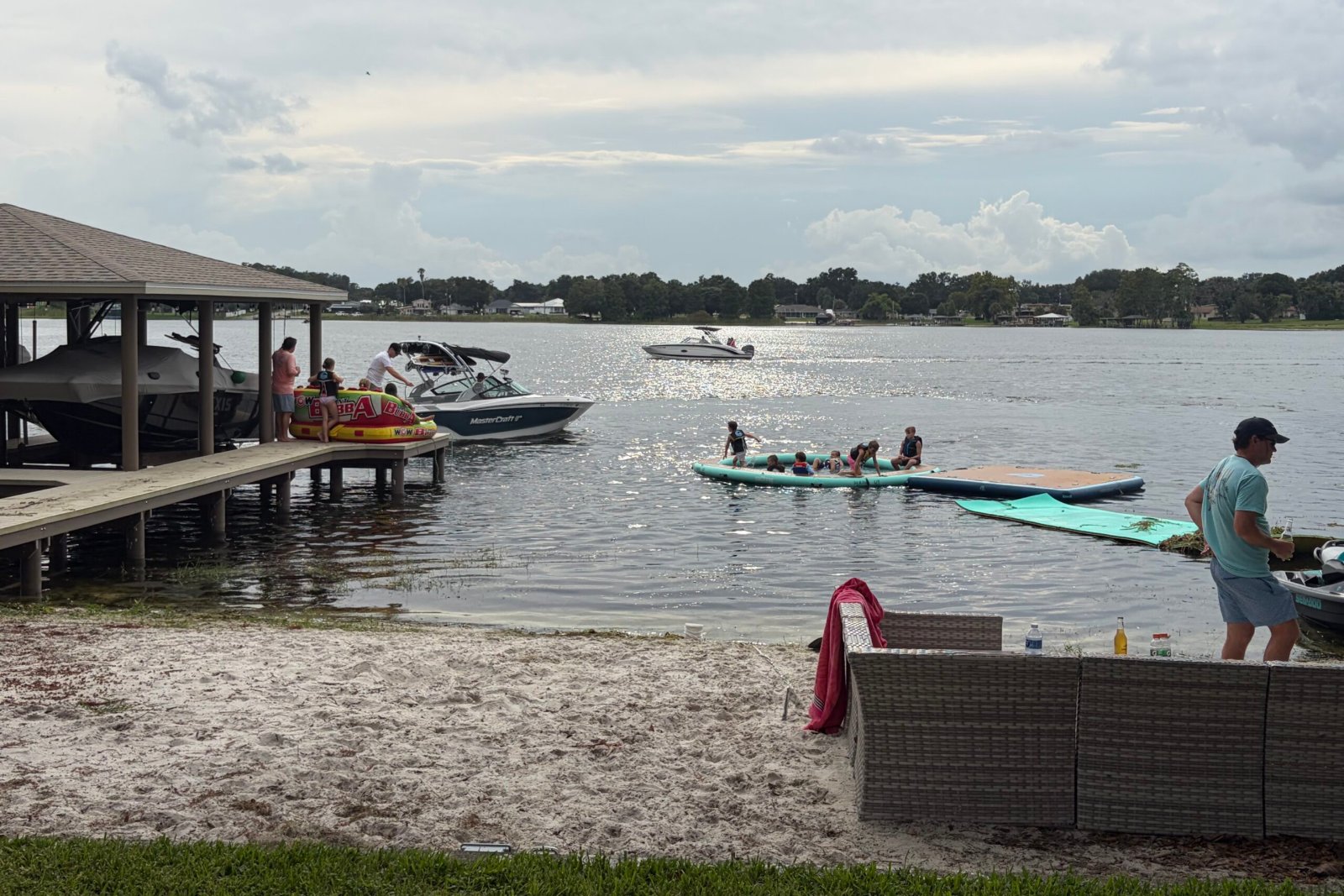
    Family and friends on a summer Saturday at a Florida lake home, with boats at the dock, kids on a floating water mat, and a sandy beach shoreline

    A busy public ramp next door, a noisy through-channel, or a low bridge that traps your boat on one section of the chain can quietly ruin the exact experience you paid a premium for.
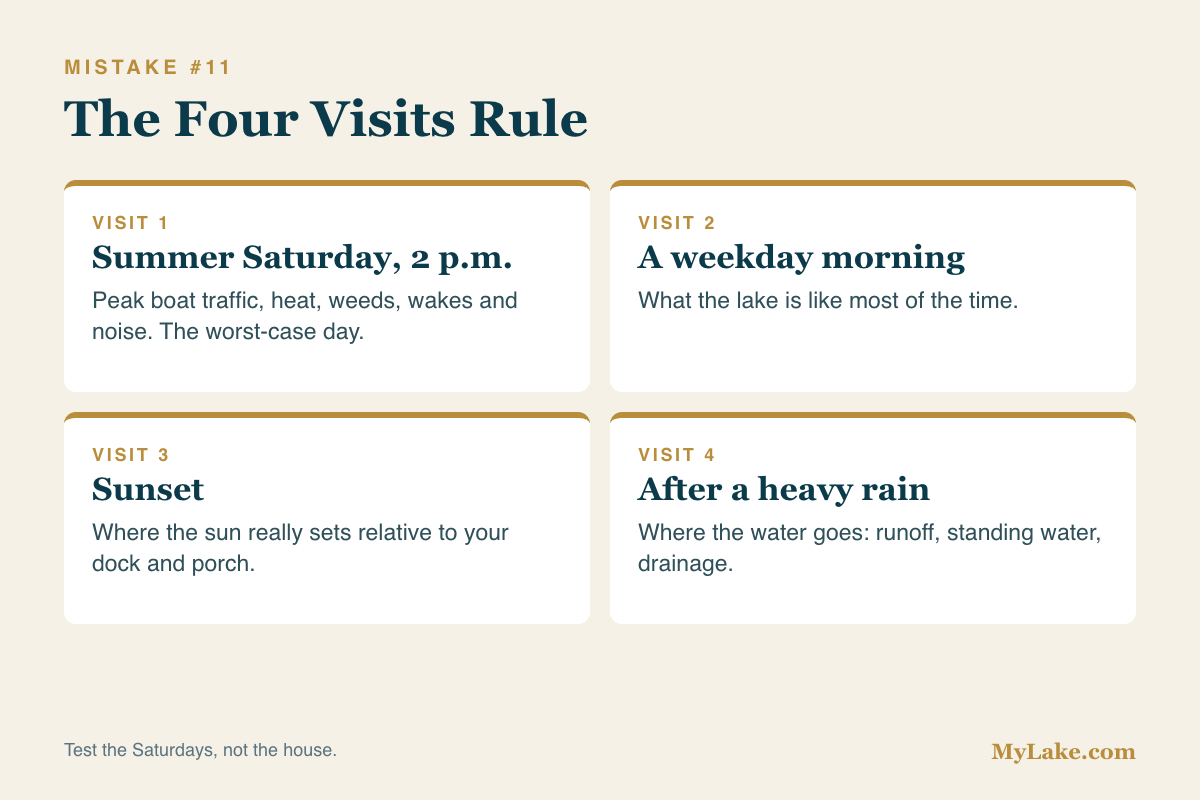
    The Four Visits Rule: visit a lake on a summer Saturday afternoon, a weekday morning, at sunset, and after a heavy rain

    The fix: Get on that specific stretch of water at four different moments before you close. Then run the chain in a boat and check the bridge clearances against your own boat.

    Get the full Florida Lakefront Buyer’s Guide (free)

    That’s the 30,000-foot view. The full 31-page guide gives you the part that actually protects your money:

    • The 60-second version: all 11 mistakes and the one-line fix for each, on a single page
    • The 10-Minute Lake Background Check: ten free public tools that show a lake’s water, weed, flood and tax history
    • The offer checklist: twelve items to hand your agent and write into your inspection period
    • Five questions to ask a neighbor, including the one I’ve never had anyone dodge
    • A plain-English glossary and every link in one place
    Florida Lakefront Buyer's Guide: 11 Costly Mistakes to Avoid When Buying a Lake Home in Florida, free 31-page download

    Send Me the Free Buyer’s Guide →

    Read it with a pen. Bring it to showings. And when you find the one, you’ll know what you’re actually buying.

    — Joe

    P.S. Rather not do all of this alone? Tell me the area you’re shopping and I’ll match you with the top lake expert agent there. Every agent I refer either lives on a nearby lake or has bought and sold a lot of lake homes. It never costs you a thing.

    This article is general information, not legal, tax, insurance or permitting advice. Rules change, so verify the details for any specific property with the appropriate agency or a licensed professional.
  • The 10 Most Expensive Lakes in Winter Haven, Florida

    The 10 Most Expensive Lakes in Winter Haven, Florida

    If you’ve been shopping lakefront in Winter Haven, you’ve seen the sticker shock.

    The most expensive lakes in Winter Haven, Florida carry median sale prices north of $1.4 million. Others on this list sit comfortably under $700K.

    The difference isn’t always the water — it’s neighborhood, access, and market momentum.

    I’ve lived on these lakes for a big chunk of my life. I lived on Lake Link with my family, rented on Lake Summit as an adult, and bought my first lake home on Lake Eloise. I’ve watched where money flows, and it tells you something about what buyers actually want — and what they’re willing to overpay for.

    Here are the 10 most expensive lakes in Winter Haven, ranked by median sale price over the last five years. I’ve included only lakes with at least two documented sales in that window.

    How I built this list: closed single-family waterfront sales from August 2021 through August 2026, pulled from Stellar MLS, plus one verified Zillow record noted below. Medians come from those closed sales only. Where a lake had just two or three sales, treat the median as directional, not precise — a single unusual house moves it.

    The 10 Most Expensive Lakes in Winter Haven at a Glance

    # Lake Median Sale Price Sale Price Range Sales
    1 Lake Eloise $1,460,000 $313,000 – $3,185,000 27
    2 Lake Summit $1,380,000 $985,000 – $1,775,000 2
    3 Lake Winterset $1,150,000 $433,000 – $2,200,000 11
    4 Lake Mirror $850,000 $587,000 – $940,000 9
    5 Lake Otis & Little Lake Otis $840,000 $400,000 – $2,349,000 10
    6 Lake Ruby $732,500 $635,000 – $1,150,000 8
    7 Lake Hamilton $715,000 $385,000 – $1,700,000 33
    8 Lake Idylwild $699,000 $630,000 – $725,000 3
    9 Lake Hart $653,500 $624,900 – $699,000 4
    10 Lake Daisy $638,500 $547,000 – $730,000 2

    Watch the Video Breakdown

    Here’s the video breakdown of these 10 lakes — watch it or keep reading for the full data and what each lake actually means for a buyer.

    #10: Lake Daisy — $638,500 Median

    Lowest sale: $547,000 | Highest sale: $730,000 | Sales volume: 2

    Lake Daisy is solid. Small lake, calm water, nice established homes. You’re in the mid-$630s as the median. The range is tight — $547K to $730K — which tells you pricing is predictable. 

    Who this lake is wrong for: Buyers expecting a lake on the chain or heavy boat traffic. Daisy is residential and quiet.

    #9: Lake Hart — $653,500 Median

    Lowest sale: $624,900 | Highest sale: $699,000 | Sales volume: 4

    Lake Hart has tight pricing: $625K to $699K. That predictability is the whole story. You’re not going to find a $300K surprise or a $1.2M outlier. If you want reliability over speculation, Hart works. Good schools nearby. Stable neighborhood. Not trendy, but solid.

    Who this lake is wrong for: Buyers betting on appreciation or looking for a lake with strong recreational culture.

    #8: Lake Idylwild — $699,000 Median

    Lowest sale: $630,000 | Highest sale: $725,000 | Sales volume: 3

    Idylwild rounds out the $700K mark. Small lake, established community. Fair warning: this lake grows hydrilla in certain years, which is manageable but not invisible. It’s worth knowing going in. Homes are solid, the community is established, and the price reflects honest lakefront value.

    #7: Lake Hamilton — $715,000 Median

    Lowest sale: $385,000 | Highest sale: $1,700,000 | Sales volume: 33

    Hamilton is interesting because it’s the volume leader — 33 sales in the data — but the range is wild: $385K to $1.7M. That’s because Hamilton touches multiple neighborhoods at different price points. Some Lake Hamilton homes are entry-level; others are showplaces. The median of $715K is your middle ground.

    What this means: A $715K Lake Hamilton home is not the same as a $385K one, even though they’re on the same lake.

    #6: Lake Ruby — $732,500 Median

    Lowest sale: $635,000 | Highest sale: $1,150,000 | Sales volume: 8

    Ruby sits in that upper-mid range. Eight homes sold; median around $732K. Clean lake, good fishing, solid community, and connects to Lake Bess (but not on the chain).

    #5: Lake Otis & Little Lake Otis — $840,000 Median

    Lowest sale: $400,000 | Highest sale: $2,349,000 | Sales volume: 10

    Otis jumps the price band. Median $840K, but watch that range: $400K to $2.35M. Again, neighborhood variance. And note this includes Lake Otis and Little Lake Otis.

    The lake itself is solid — good water, reasonable size, and connects to Lake Link (but not the chain). At $840K-plus, you’re paying for location as much as you’re paying for lake.

    #4: Lake Mirror — $850,000 Median

    Lowest sale: $587,000 | Highest sale: $940,000 | Sales volume: 9

    Mirror is tight pricing: nine homes, $587K to $940K, median $850K. Clean water, good neighborhood feel. Not flashy, but honest lakefront with stable pricing on the chain of lakes. This is real demand from real buyers, not speculation.

    #3: Lake Winterset — $1,150,000 Median

    Lowest sale: $433,000 | Highest sale: $2,200,000 | Sales volume: 11

    Winterset is where premium pricing starts. Median $1.15M, and the high hit $2.2M. This is the lake where reputation carries weight. Winterset homes are established, the neighborhood is solid, and you’re paying for the name as much as the water.

    #2: Lake Summit — $1,380,000 Median

    Lowest sale: $985,000 | Highest sale: $1,775,000 | Sales volume: 2

    Summit is small but high in price: $985K and $1.775M, median $1.38M. This is a busy lake (with a boat ramp) and it connects to the chain via Lake Eloise.

    #1: Lake Eloise — $1,460,000 Median

    Lowest sale: $313,000 | Highest sale: $3,185,000 | Sales volume: 27

    And here’s Lake Eloise. $1.46M median, but the range tells the real story: $313K to $3.185M. That’s because Eloise touches multiple neighborhoods and price points. But make no mistake: Eloise is where the top-tier homes in Winter Haven are priced.

    I live on this lake. I’ve watched it change over decades. Eloise has volume, visibility, and older established neighborhoods with big homes and deep lots. You’re paying for stability and the fact that more people want to be here than on any other lake I know. It is also where I made the three mistakes I wrote about buying my own Lake Eloise home — worth reading before you fall for a lake and stop asking questions.

    A note on the data: Some high-value sales may not appear in standard MLS data if they were private transactions or if the listing didn’t carry the correct “water frontage” designation. The $3.185M sale, for example, came from a verified Zillow listing. If you’re evaluating your own lake purchase, don’t rely on summary rankings alone — pull the actual sales history for the specific street or neighborhood you’re considering.

    What You’re Actually Paying For on Winter Haven’s Most Expensive Lakes

    Here’s the honest read on the most expensive lakes in Winter Haven: price correlates to three things.

    One: Neighborhood age and stability. Older, established neighborhoods with big lots and mature trees command premium pricing. Lake Eloise has that. Some of the other lakes don’t.

    Two: Market momentum. Lakes with steady sales volume and a deep pool of buyers hold their pricing. Eloise moved 27 homes and Hamilton 33. Summit moved two. Thin volume cuts both ways — it can mean scarcity, or it can mean a small, slow market where one bad comp sets the tone for a year.

    Three: Water quality and recreational access. Lakes with clean water, good fishing, and documented chain connectivity move higher. The data is public and free — the Polk County Water Atlas and Florida LAKEWATCH both publish years of sampling on these lakes. People who do their homework price homes smarter.

    You’re not always paying for the lake itself. You’re paying for the neighborhood, the lot, the chain life, and the market momentum. That’s what separates a smart buy on one of the most expensive lakes in Winter Haven from an overpaid one.

    Winter Haven Lake Home FAQs

    What is the most expensive lake in Winter Haven, Florida?

    Lake Eloise, at a $1,460,000 median sale price across 27 sales over the last five years. Individual sales ran from $313,000 to $3,185,000, so the median sits in the middle of a very wide field.

    How much does a lake home in Winter Haven cost?

    On the ten most expensive lakes in Winter Haven, medians run from $638,500 on Lake Daisy to $1,460,000 on Lake Eloise. Winter Haven has lakefront well below that range too — this is the top ten by median price, not the whole market.

    Which Winter Haven lake is the best value?

    That really depends on your goals…

    Just remember, you can change/update the lake house; you can’t change the lake (so buy the lake first, house second).

    Next Steps

    Three women relaxing on a giant inflatable flamingo float on a Winter Haven lake, with a dock and lakefront home behind them

    If you are narrowing your search to a specific lake in Winter Haven, do not decide on median prices alone. A median tells you what the market cleared. It does not tell you whether the dock is grandfathered, whether the property tax bill resets the day you close, or what the surface of that lake looks like in August.

    That is what I put in the free guide: 11 Costly Mistakes to Avoid When Buying a Lake Home in Florida. It is 31 pages, it is free, and it includes a 10-minute background check you can run on any lake on this list before you ever write an offer.

    Already settled on a lake and want someone local? Get matched with a lake expert — free, no obligation. Every agent I work with lives on a lake themselves.

  • 3 Mistakes I Made Buying a Lake House in Florida

    3 Mistakes I Made Buying a Lake House in Florida

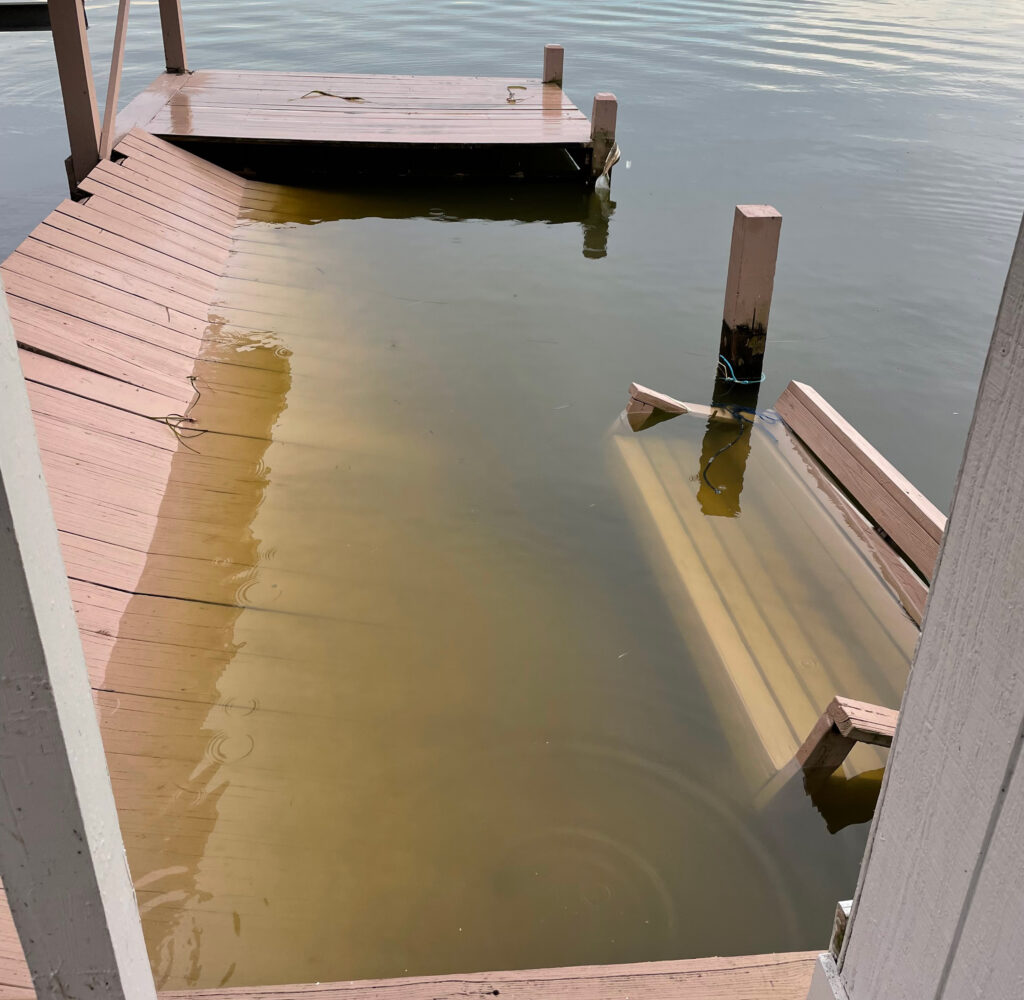
    Three months after we finally closed on our dream lake house in Florida, our dock collapsed and went into the water.

    Even worse, I was standing on the dock when it happened…

    Fortunately, I wasn’t hurt (besides my pride).

    And fortunately, the entire dock didn’t collapse all at once.

    Instead, a huge section under my feet snapped in half and dropped me right into Lake Eloise.

    I came up shocked and soaking wet.

    I remember holding my fishing rod in one hand (and what was left of the beer I was drinking in the other hand) and immediately regretting a decision I had made a few months prior…

    Which leads me to the worst part of this story (besides having an unusable dock and being wet).

    a dock on lake eloise that collapsed
    Here’s what the dock looked like shortly after I fell in (I was standing on the right side near the bench)

    The worst part is that I had a quote to replace the dock before we ever moved in (so we could have moved into a house with a brand new dock ready for action).

    The quote was about forty thousand dollars.

    I passed because I figured I could get another year or two out of the existing old dock…

    By the time a builder could actually get to us, the same dock cost closer to fifty thousand, and we’d spent most of a year owning lakefront we couldn’t really use.

    That’s mistake number three. The first two happened before we signed anything, and one of them nearly cost us the house.

    Before you write me off as some guy who had never been around a lake: I grew up on Lake Link, spent a year on Lake Hatchineha, and rented on Lake Summit as an adult. I have been on Florida lakes basically my whole life.

    Lake Eloise was just the first one I ever bought.

    Turns out those are two very different things.

    Mistake #1: I spent 18 months waiting for a better time to buy a lake home

    My wife Loren and I looked at lake homes for a year and a half before we bought one.

    Not casually. We toured houses. We looked at Zillow every day. We ran the numbers.

    And every single time we landed in the same place: not yet. Wait until we’ve saved more. Wait until the right one comes along at the right price. Wait until it feels responsible.

    In those eighteen months we passed on several houses that, knowing what I know now, were good deals. Actually, VERY good deals.

    Every one of them felt out of our budget at the time. Every one of these lake homes would look like a bargain today.

    Then we found the one on Lake Eloise, and we almost did it again.

    We were days from backing out. It felt like too much money.

    That’s the day Chris called.

    The phone call that changed the math

    Chris is an old friend, but we hadn’t spoken in about a year.

    He called for no particular reason… just to catch up on life.

    I ended up telling him that we were about to cancel our offer on a lake house.

    He asked me if I had time to hear his biggest regret in life…

    Years ago, he’d bought the affordable house.

    The sensible one, the one where the math worked.

    And his two daughters never wanted to be there. They wanted to be at their friend’s house, the one with the view, the one that was fun. So that’s where they were. He spent a big chunk of their childhood picking them up from somebody else’s house.

    OUCH.

    He said he’d pay anything to have been the house the kids came to.

    He urged me not to make the same mistake he did.

    He said, “Assuming you are financially approved to buy this lake house and that it doesn’t wipe away 100% of your savings, do it. You’ll make it work and you won’t regret it.”

    So we did.

    We closed in mid 2021, right in the thick of the COVID housing boom, before Florida lakefront home prices did what they did over the following two years.

    Here’s the actual lesson, and it isn’t “buy the expensive house.”

    It’s that I was running the wrong math.

    I kept comparing a purchase price against a savings balance. What I never put a number on was the amount of memories our family would create at our lake house, along with the countless times their friends wanted to come to OUR house (and not the other way around).

    That number isn’t zero. It just doesn’t show up on a mortgage worksheet.

    I also didn’t factor in what buying on the RIGHT lake (aka a lake in demand) does over time. I’m not going to tell you lake property only goes up, because it doesn’t. Florida lakefront got hit hard from 2007 to 2011 along with everything else. But demand for the GOOD lakes has held up better than the market around them, and nobody is making any new ones.

    And we certainly benefited from buying a lake home in Florida in early 2021…

    Let me be clear, I’m not telling you to hurry.

    Buying a lake home you can’t afford is a much more expensive mistake than waiting a year.

    But “we’ll do it when we have more money” is not a plan, and for us it was really just a way of not deciding.

    Mistake #2: I spent that year and a half shopping lake houses, not lakes

    For most of those eighteen months I did what everybody does. Open Zillow. Filter by price, beds, baths, square footage, waterfront. Sort by newest.

    Judge the house.

    Nobody sorts by lake.

    There’s no filter for it.

    So it never occurred to me that choosing your lake mattered most.

    After countless searches, it came down to two houses: a newer, nicer lake home that isn’t part of the Winter Haven chain, and an older, WAY outdated house on Lake Eloise.

    We took the ugly, outdated lake house…

    It was the best decision we made!

    The reason isn’t that Lake Eloise is better looking or in a better part of town.

    It’s that Eloise is on the Winter Haven Chain of Lakes.

    From our dock we can run to other lakes, tie up at a restaurant, take the boat over to our best friend’s house (who live on the next lake over), and get on water that’s big enough to actually do something on.

    The other house had a lake you could look at (and that’s about it).

    The Lesson: You can fix a house. You cannot fix a lake.

    A dated kitchen, ugly bathrooms, a bad elevation — those are a budget and a contractor.

    But you can’t add chain access to a lake that doesn’t have it.

    You can’t fix a lake with a chronic algae history, or a mucky bottom, or water that drops far enough in the dry season to leave your dock sitting in mud.

    Whatever the lake is, that’s what you bought.

    What you are actually buying when you buy the lake

    • Chain access – can you run to other lakes, or are you circling the same one all day?
    • Algae and hydrilla history – not what it looked like the week you toured
    • Bottom composition – sand or muck where your dock and swim area go
    • Dry season water level – how far it drops, and whether your dock ends up sitting in mud
    • Traffic and access – public ramps, boat pressure, who else is out there on a Saturday

    Every one of those is knowable before you ever write an offer.

    None of it is on the listing.

    If you are trying to work out which Winter Haven lake to aim at, price is a decent first signal. I ranked the 10 most expensive lakes in Winter Haven by median sale price, with the five-year sales range on each one. It shows you where the demand actually sits before you fall in love with a house.

    That gap is the reason MyLake.com exists.

    The house comes with forty photos, a floor plan, an inspection, and a disclosure.

    The lake — the part you can’t undo — comes with almost nothing a normal buyer can find.

    Here are the 11 most costly mistakes to avoid when buying a lake home in Florida. It’s free.

    Mistake #3: I went cheap on the dock

    Back to the dock story.

    As I mentioned, the house we bought was over 50 years old, and nothing had been updated (as in literally nothing).

    That being said, we had a little work being done on the house before we moved in.

    While those crews and different contractors were on site, a dock builder quoted me about $40,000 to tear out the thirty-year-old dock and put in a new one.

    That would have meant we’d have a finished, new dock in the same month we moved in.

    I looked at that $40,000 number sitting next to everything else we were already spending and told myself the existing old dock had lasted thirty years and could give us a couple more.

    It looked ugly, but not unsafe. That was my read.

    Three months later it was unsafe, with me on it.

    The money was the smaller half of it.

    This was 2021; builders were running out of materials, and backlogs were stacking up.

    It took me over six months just to get back on a dock builder’s schedule — then demo, then build.

    The same dock I had been quoted about $40,000 for was now closer to $50,000. Thanks Covid!

    The part I didn’t see coming…

    I thought of the dock as the amenity to the lake house.

    The dock IS the house.

    We use it nearly every day!

    The dock has become our place of peace (and joy).

    I go down to the dock and feed the fish (and turtles) every day. After the feeding frenzy dies down, I sit in one of our Adirondack chairs, look out over the water, and take it all in.

    Some days it’s a bald eagle flying right near the dock, some days it’s watching the curious otters swim by, and some days it’s watching the ospreys dive down for fish.

    Each day is different at the lake, but one thing remains the same… that feeling of peace.

    Six months of owning a lake house without a usable dock taught me what the dock was worth better than any quote could have.

    Who this advice is wrong for

    I’ll be honest, buying a lake house in Florida isn’t for everyone…

    If you don’t want a boat, don’t want to maintain a dock (and perhaps a seawall), and want a house you can move into without touching anything — then trading a nicer house for a better lake is the wrong call for you.

    You’ll be paying a lakefront premium and a maintenance bill for water you look at.

    The trade I made only pays off if you’re actually going to get on the water. Be honest with yourself about that before you pay for it.

    What I’d tell you to do first

    Pick the lake before you pick the house. Everything else is reversible.

    I wrote up the full list of what goes wrong — eleven mistakes, what each one costs, and how you’d catch it before closing. It’s free, and it’s the guide I wish somebody had handed me in 2020.

    → Get the free guide: 11 Costly Mistakes to Avoid When Buying a Lake Home in Florida

    Questions about a specific lake in Polk County? Ask me here. Free, no pressure.

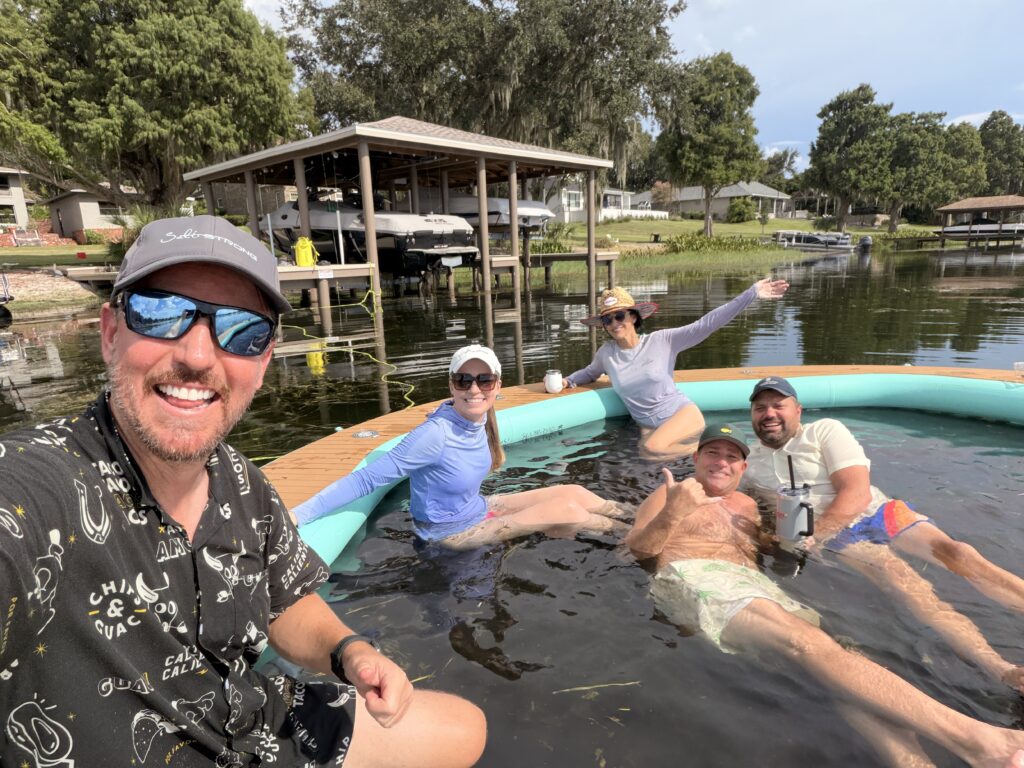
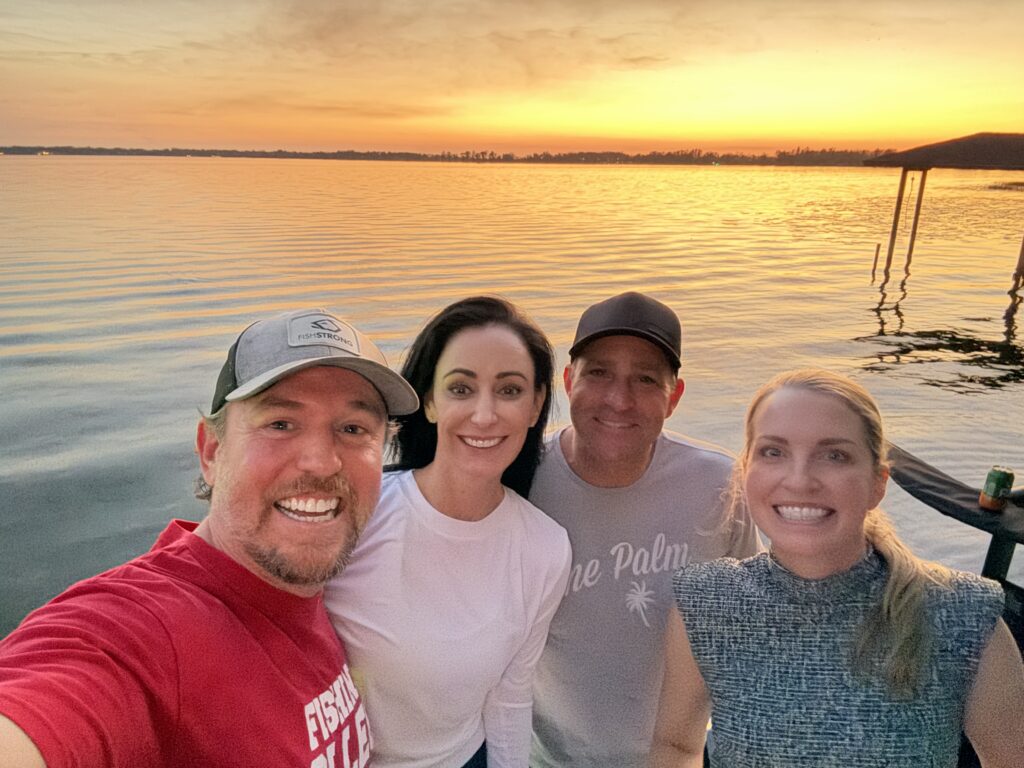
    Joe Simonds with friends on the dock at Lake Eloise, all of whom live on the Winter Haven Chain of Lakes
    Here’s me with some of our best friends (who all live on the Winter Haven chain of lakes)